GROUNDWORK
Six movement patterns and three full-body sessions a week. Week one is for learning the lifts.
Written by Strengthara (Zenta AB) · Updated
New to lifting, or back after a long break.
How to rotate the workouts
Alternate Full Body A and Full Body B. Start with two training days per week, with a rest day between them. If you train three times, continue A, B, A, then B, A, B the following week.
Take rest days between workouts as you need them. If you miss a day, continue with the next workout in the rotation rather than restarting. Strengthara lets you choose each workout; it does not schedule or advance the rotation for you.
Read the prescription
Sets are working sets. Reps show a fixed number, a range, or a duration; per side means repeat on each side. RIR means reps in reserve: 2 RIR means stopping when you judge you could do about two more clean reps. Rest is between working sets, or the easy interval in interval work. An empty value means that field is not prescribed.
Warm up before the working sets: practise the movement and build toward your working load with easier sets. The tables do not prescribe a starting weight. Choose one that lets you finish the reps with the stated RIR and controlled technique.
Full Body A
Squat, press, row, hinge: the four big patterns.
| Exercise | Sets | Reps | RIR | Rest | Notes |
|---|---|---|---|---|---|
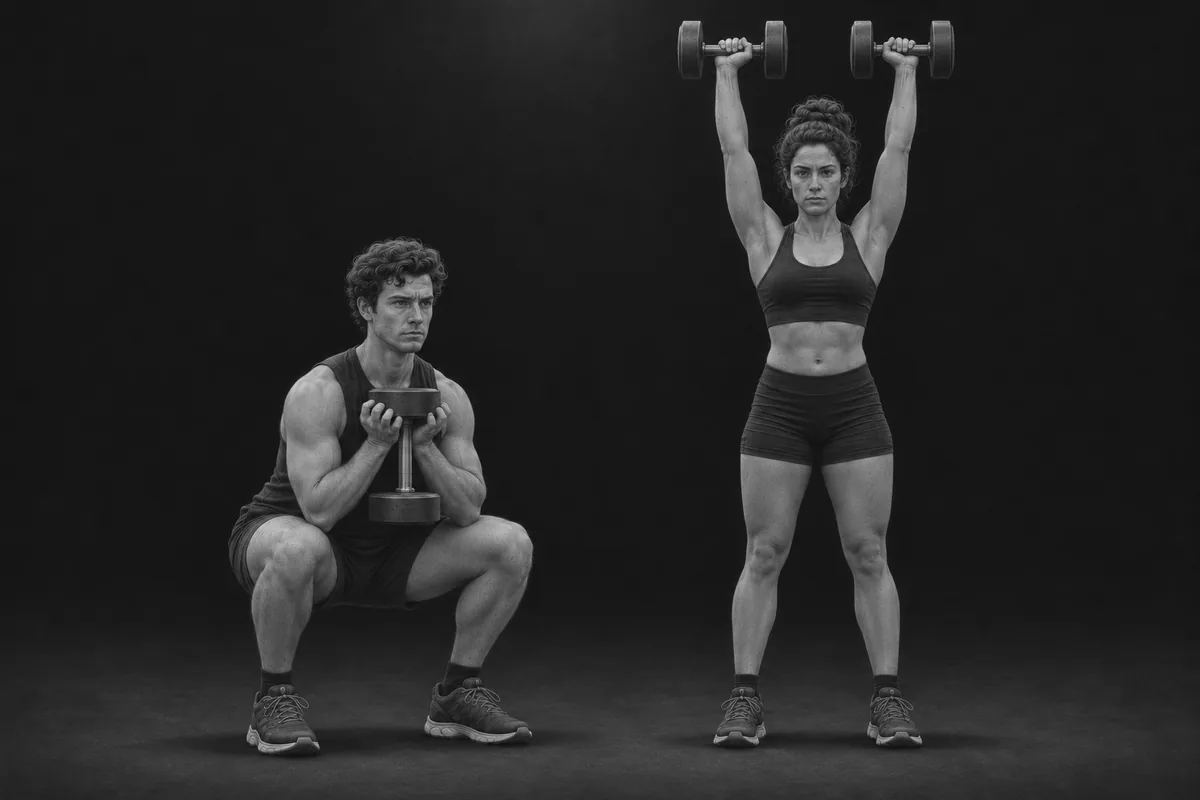
| Goblet Squat | 3 | 8–12 | 2 | 120 s | Sit between the hips; elbows inside knees. Squat pattern for the back squat later. |
| Dumbbell Bench Press | 3 | 8–12 | 2 | 120 s | Load is per dumbbell. Horizontal press. |
| Seated Cable Row | 3 | 10–15 | 2 | 90 s | Chest tall, pause at the ribs. Horizontal pull. |
| Dumbbell Romanian Deadlift | 3 | 8–12 | 2 | 120 s | Stop when the hamstrings stretch; back stays flat. |
| Plank | 3 | 30 s | – | 60 s | When all three holds feel easy, add 10 s. |
Full Body B
Leg press, overhead press, pulldown, hip thrust and a push-up you can progress.
| Exercise | Sets | Reps | RIR | Rest | Notes |
|---|---|---|---|---|---|
| Leg Press | 3 | 10–15 | 2 | 120 s | Knee-dominant, no balance demand. Lower until hips start to tuck, no further. |
| Dumbbell Shoulder Press | 3 | 8–12 | 2 | 120 s | Vertical press. Ribs down. |
| Lat Pulldown | 3 | 8–12 | 2 | 90 s | Vertical pull. Bar to upper chest. |
| Hip Thrust | 3 | 10–15 | 2 | 90 s | Barbell or machine. Second hinge-family slot of the week. |
| Incline Push-up | 3 | 8–15 | 2 | 60 s | Hands on a bench or the Smith bar. When you get 3×15, lower the incline next time; when you can do 3×8 on the floor, log Push-ups instead. |
| Dead Bug | 2 | 8 per side | – | 60 s | Lower back stays on the floor. |
Choose your next load using Last time
Strengthara shows what you logged Last time. You decide the load and reps today. For exercises with a rep range, this is one way to use double progression:
- Begin with a load that lets every working set reach the bottom of the rep range at the prescribed RIR.
- Keep that load and add reps over later sessions while keeping the RIR and technique. Log each set as performed, even when sets differ.
- Once every working set reaches the top of the range at the prescribed RIR, try the smallest load increase your equipment allows next time. Work up through the range again.
- If you cannot reach the lower end with the intended RIR, keep or reduce the load. If progress stalls across several sessions, review rest, recovery and technique before adding more work.
Example: for 3 sets of 8–12 at 2 RIR, Last time might show 12, 11, 10 reps. Keep the load and work toward 12, 12, 12. When all three reach 12 with about two reps left, try a small increase next time. No fixed load jump is required.
For fixed-rep lifts, keep the prescribed reps and use RIR to judge whether a small increase is manageable. For timed, bodyweight and conditioning work, follow the exercise notes. The app neither progresses loads nor changes the written prescription automatically.
Sources: ACSM (2009) supports gradual resistance progression; Zourdos et al. (2016) describes the RIR scale. The exact double-progression rule and rotation examples here are our practical guidance, not a claim that either study tested these five programs.
Follow it free in Strengthara
Open the block picker, choose this block template and sign in to create your block. Make it active, then choose a workout in the iOS app. Log the sets you actually do. The Logbook and Last time are included in Free. Editing the program or creating your own needs Pro.
Follow a program freeMethod
Checked
Workout names, exercises, prescriptions, coaching notes and audience come from the anonymous block templates endpoint during the site build. They are a build-time edition of the catalogue; an existing block keeps its own copy. The rotation and progression guidance below are editorial instructions you apply yourself.
Sources
- Strengthara block template catalogue (anonymous API)
StrengtharaAccessed
- American College of Sports Medicine (2009). Progression Models in Resistance Training for Healthy Adults. Medicine & Science in Sports & Exercise, 41(3), 687–708. doi:10.1249/MSS.0b013e3181915670
ACSMAccessed
- Zourdos et al. (2016). Novel Resistance Training–Specific Rating of Perceived Exertion Scale Measuring Repetitions in Reserve. Journal of Strength and Conditioning Research, 30(1), 267–275. doi:10.1519/JSC.0000000000001049
NSCAAccessed